No Purchase Necessary: What It Means and How to Offer a Free Entry
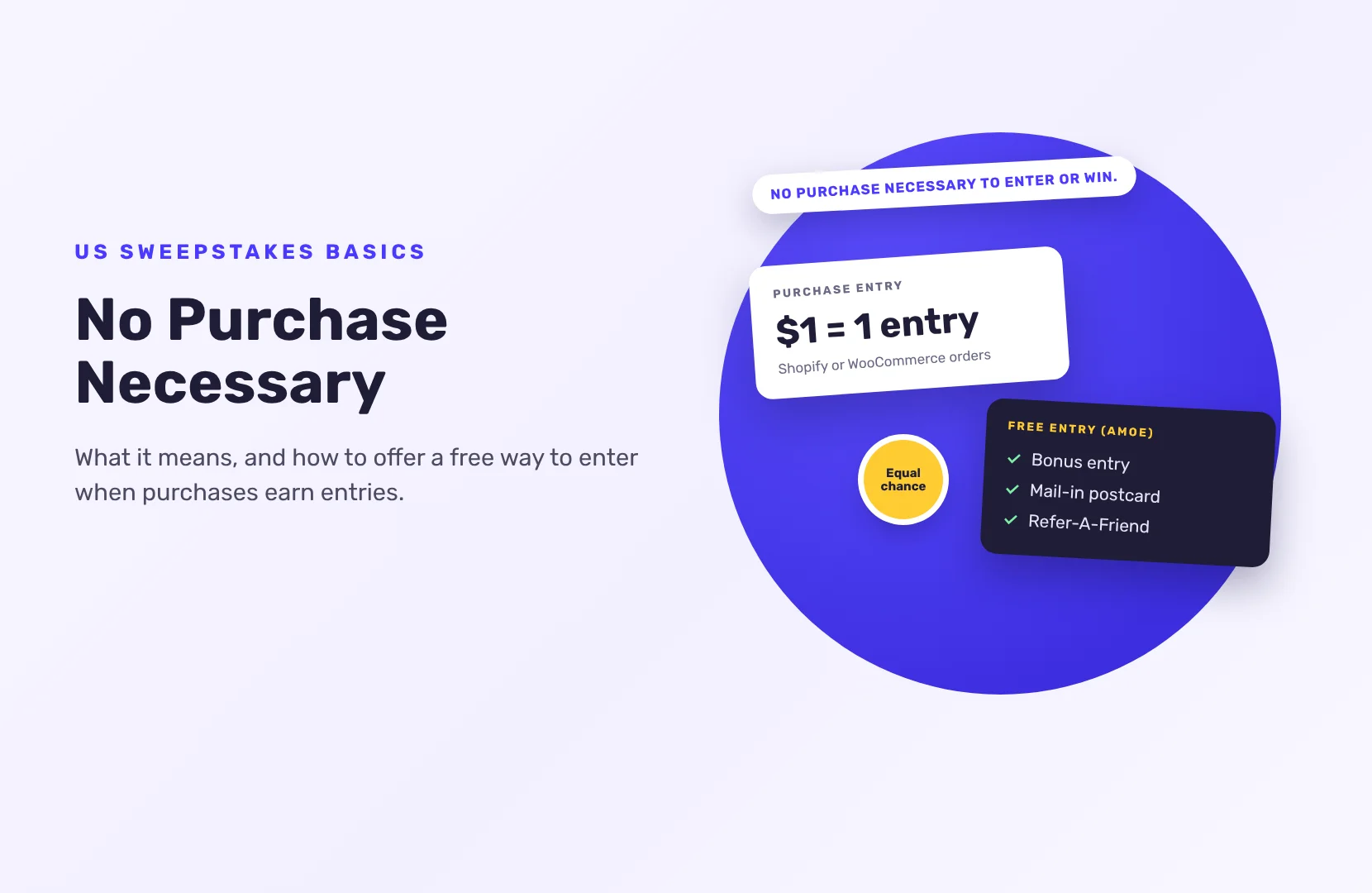
“No purchase necessary” means anyone can enter a sweepstakes and win without buying anything, and that buying doesn’t improve their chances. If you give entries for purchases, you also need a free way to enter, often called an alternative method of entry (AMOE).
This guide explains the general rules in plain language. It isn’t legal advice. Rules change and depend on where you and your entrants are, so check with a lawyer before you launch a large or multi-state promotion.
Why “no purchase necessary” matters
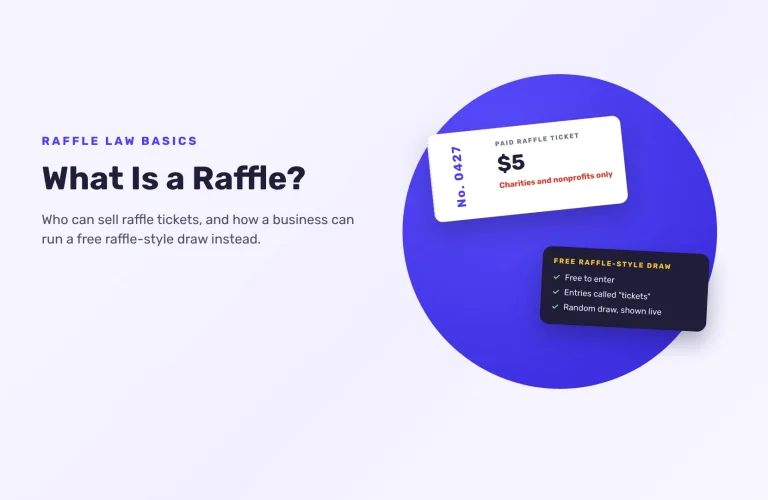
A lottery has three parts: a prize, chance and consideration (paying to play). Remove any one of the three and it isn’t a lottery. States such as New York and Florida treat a lottery run without their authority as unlawful (N.Y. Penal Law §225.00, Fla. Stat. §849.09). If you want people to pay for their chances, that’s a raffle, which has its own rules.
A sweepstakes keeps the prize and the chance and takes out the payment. Federal law defines it as “a game of chance for which no consideration is required to enter” (39 U.S.C. §3001(k)). “No purchase necessary” is how you tell entrants, and regulators, that your promotion is the second kind.
The FTC is direct about it: real sweepstakes are free, and “it’s illegal to ask you to pay or buy something to enter or to increase your odds of winning” (FTC). Florida’s game promotion law makes it unlawful to require “an entry fee, payment, or proof of purchase” to enter (Fla. Stat. §849.094), and New York’s registration law covers prizes given “without any consideration” (N.Y. Gen. Bus. Law §369-e).
What does the statement have to say?
The most specific federal wording is for sweepstakes sent through the US mail. It doesn’t cover online-only promotions, but it’s the clearest model. Under the Deceptive Mail Prevention and Enforcement Act (39 U.S.C. §3001(k)), the mailing, the rules and the entry form must each say:
- that no purchase is necessary to enter, and
- that a purchase will not improve the chances of winning.
The law also asks for these statements to be displayed so they’re easy to notice, read and understand.
For online giveaways, most sponsors use the same two sentences. A common version:
NO PURCHASE NECESSARY TO ENTER OR WIN. A PURCHASE WILL NOT INCREASE YOUR CHANCES OF WINNING.
Where to put it
- At the top of your official rules. It’s the first line in most rules templates.
- On the entry page, near the entry form, along with a short line on how to enter for free.
- In ads and posts, with a link to the full rules. Florida lets an ad give just the main terms plus a website, toll-free number or mailing address for the full rules, which is a useful model everywhere.
Don’t hide it in small grey text. A statement nobody can find doesn’t do its job.
What counts as a free way to enter?
An alternative method of entry should be something anyone can do without paying and without much effort. Common options:
- A free online entry. The same entry page, without the purchase step.
- Mail-in. People send a postcard with their name and contact details to an address in your rules, by a set date.
- Email. People send their details to a set address.
Whatever you choose, explain it step by step in your rules, make it easy to find, and treat free entries the same as paid ones in the draw. California’s sweepstakes law, for example, says entries sent without an order can’t be put at any disadvantage when winners are picked (§17539.15(c)).
How many entries should a free entry get?
This is the part that needs the most care. If spending earns extra entries, a buyer’s chances go up with every order. That’s exactly what the FTC and the mail law say a purchase can’t do.
So the free route has to be able to keep up. Sweepstakes lawyers call this “equal dignity”: someone who enters for free should be able to get the same chance as someone who buys (Holland & Knight). A common way to do it is to give each free entry as many entries as a typical purchase earns. If most orders are around $50 and you give 1 entry per $1, a free entry gets 50. Then cap total entries per person at a level a free entrant can reach (Verrill). The right balance depends on your promotion and where it runs, so agree it with your lawyer before launch and write it into your rules.
How to offer a free entry in SweepWidget
SweepWidget can give entries for purchases on Shopify and WooCommerce (Pro plan and up), for example a set number of entries for every dollar spent. Here’s how to keep a free route next to it:
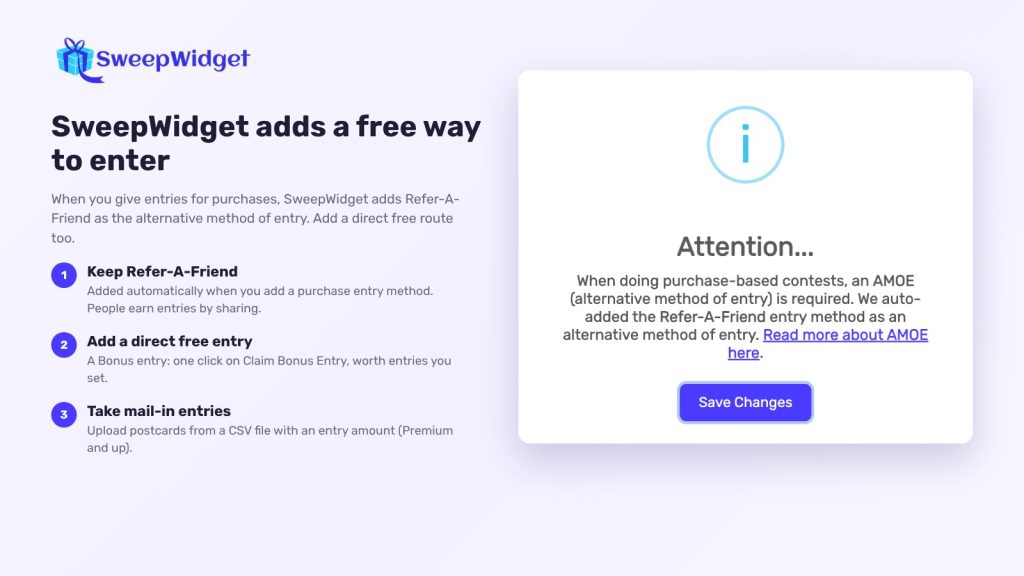
- Keep the automatic Refer-A-Friend entry. When you add a purchase entry method, SweepWidget adds Refer-A-Friend automatically, so people can earn entries by sharing instead of buying. Don’t remove it.
- Add a direct free entry too. Referral entries depend on friends joining, so add a way to earn entries on your own. The Bonus entry method (Pro plan and up) gives entries for one click on Claim Bonus Entry, and you set how many entries it’s worth. Tick Allow daily re-entry so free entrants can keep coming back over a long giveaway.
- Keep the numbers close. Set entries per dollar so a typical order earns about what your free entry gives, and set the Bonus entry to that number. Spending shouldn’t be able to run far ahead of the free route.
- Take mail-in entries. List the mailing address in your rules. On Premium and up, upload the postcards from a CSV file with an entry amount for each person, and they join the same draw. The upload skips any email already in the giveaway, so check for people who also entered online and make sure their mail-in entries still count.
- Put the statement in your rules. SweepWidget’s terms and conditions generator starts the rules with “NO PURCHASE IS NECESSARY TO ENTER OR WIN. A PURCHASE DOES NOT INCREASE THE CHANCES OF WINNING.” Add your free entry method and edit the rest to fit your promotion. More in sweepstakes official rules.
For a full walkthrough of the options, read SweepWidget’s guide to alternative methods of entry (AMOE). For the store side, see how to run a Shopify giveaway that drives sales.FAQ
FAQ
You can enter and win without buying anything, and buying doesn’t improve your odds. It’s what separates a sweepstakes from a lottery.
An alternative method of entry: a free way to enter a promotion that otherwise gives entries for purchases. Mail-in, a free online form or email are common.
If every way to enter is already free, the whole promotion is the free method. You still say “no purchase necessary” in your rules.
That’s the risky part. The FTC says it’s illegal to require a purchase to increase someone’s odds. Set the balance between paid and free entries with a lawyer. A common approach is to give a free entry as many entries as a typical purchase and to cap entries per person.
It’s a common line in rules, but it doesn’t turn a paid entry into a free one. You still need a free way to enter and the disclosures your promotion calls for.