Sweepstakes Official Rules and Giveaway Terms and Conditions (Free Template)
Sweepstakes official rules are the full terms of your promotion: who is running it, who can enter, how to enter for free, when it starts and ends, what the prizes are worth, the odds, and how winners are picked and contacted. Most people searching for a “giveaway terms and conditions template” also want the same document. US law doesn’t hand you a single form, but federal and state rules point to the same core list, and the template below covers it.
This guide explains the general rules in plain language. However, it isn’t legal advice. Rules change and depend on where you and your entrants are, so check with a lawyer before you launch a large or multi-state promotion.
Official rules or terms and conditions?
For a giveaway, though, they’re the same document. “Official rules” is the usual term for a sweepstakes, and “terms and conditions” is what most people search for. Either way, it’s the agreement between you and every entrant, and it’s what you’ll point to if a winner or a platform asks how the giveaway worked.
Why do sweepstakes need official rules?
A sweepstakes is a prize draw decided by chance. So the thing that keeps it legal is that nobody has to pay to enter.
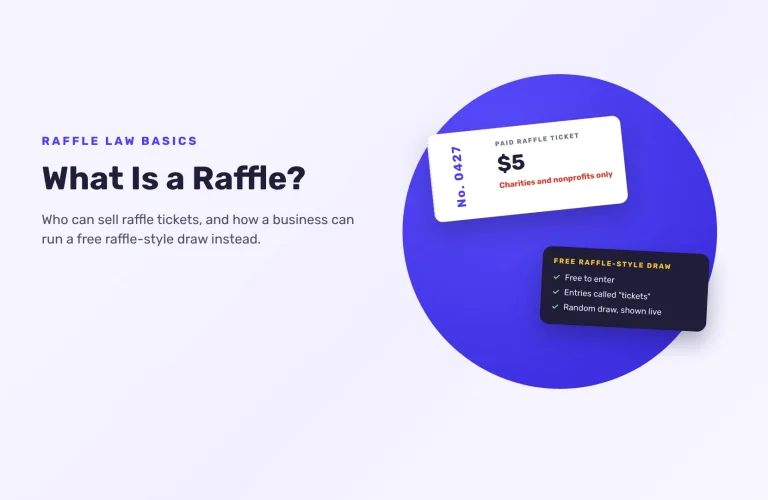
US postal law defines a sweepstakes as “a game of chance for which no consideration is required to enter” (39 U.S.C. §3001(k)). But add a required payment and you have the three parts of a lottery: a prize, chance and consideration. In other words, remove any one of the three and it isn’t a lottery. That’s why a paid raffle needs different rules from a free giveaway.
The FTC also puts it plainly for consumers: real sweepstakes are free, and it’s illegal to ask people to pay or buy something to enter or to improve their odds (FTC).
In short, your official rules are where you prove all of that in writing. They’re also the page you point to when someone asks how the winner was chosen.
What does US law require in the rules?
The federal checklist (mailed sweepstakes)
The Deceptive Mail Prevention and Enforcement Act added the most detailed federal list to 39 U.S.C. §3001(k). However, it applies only to sweepstakes sent by mail. Online rules don’t fall under this mail law, but its list is a sensible minimum for any rules. Specifically, a mailed sweepstakes must state:
- That no purchase is necessary to enter
- That a purchase won’t improve the chances of winning
- All terms and conditions, including the rules and how to enter
- The sponsor’s name and an address where they can be reached
- The estimated odds of winning each prize
- The quantity, estimated retail value and nature of each prize
- The schedule of any prize paid over time
In addition, the “no purchase” statements must appear in the mailing, in the rules and on the entry form, and be easy to notice, read and understand.
State registration and bonding
Some states also add paperwork for big prize pools:
- New York: for a game-of-chance promotion with prizes over $5,000 in total, the sponsor files with the Secretary of State at least 30 days before the start, keeps a trust account or surety bond for the full prize value, and files a list of winners of prizes over $25 within 90 days after the end. The rules must also state the time period and geographic area (N.Y. Gen. Bus. Law §369-e). The filing fee is $100 (New York Department of State).
- Florida: for a game promotion with prizes over $5,000 in total, the sponsor files the rules and prize list with the Department of Agriculture and Consumer Services at least 7 days before the start, with a trust account or surety bond (the Department can waive this for a business that has run game promotions in Florida for at least 5 years in a row with no enforcement action against it), and can’t change the rules once filed. Afterwards, winners of prizes over $25 are reported within 60 days. The rules must appear in all advertising, or the ad can give just the main terms plus a website, toll-free number or mailing address where the full rules are. Finally, requiring an entry fee, payment or proof of purchase is unlawful (Fla. Stat. §849.094).
Other states have their own rules. So if your prizes are large, check every state you’re open to. For New York, Florida and Rhode Island, see is my giveaway legal?, and for California, California sweepstakes rules.
Taxes
Prizes count as income for the winner, at fair market value if the prize is goods or services (IRS Publication 525). For tax years starting after 2025, businesses report prizes and awards of $2,000 or more on Form 1099-MISC, up from $600, and the threshold may be adjusted for inflation from 2027 (IRS instructions). That’s why your rules should say that taxes are the winner’s responsibility and that you may ask for tax details.
Social media entries and platform rules
If people enter by posting about you, the FTC says those posts should make clear they’re part of a promotion. So put your brand and the word “contest” or “sweepstakes” in the hashtag, like #AcmeSweepstakes. A bare brand hashtag isn’t enough, #sweepstakes on its own isn’t either, and “sweeps” is too vague (FTC Endorsement Guides FAQ). Also tell entrants where to put it, ideally at the start of the post. More in FTC rules for giveaways.
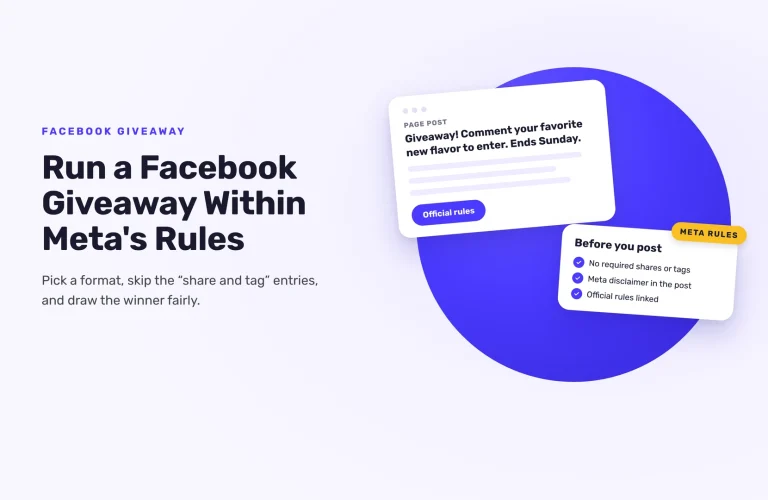
The platforms also add their own conditions. Meta’s Pages, Groups and Events policy says a promotion run on Facebook must include a complete release of Facebook by each entrant and an acknowledgement that it isn’t sponsored, endorsed or administered by, or associated with, Facebook. Similarly, Instagram’s Promotion Guidelines ask for the same about Instagram. Facebook also doesn’t allow entries for sharing on a personal timeline or tagging friends, so leave those out of the entry methods for Facebook. More in Instagram contest rules and how to run an Instagram hashtag contest.
What should official rules include?
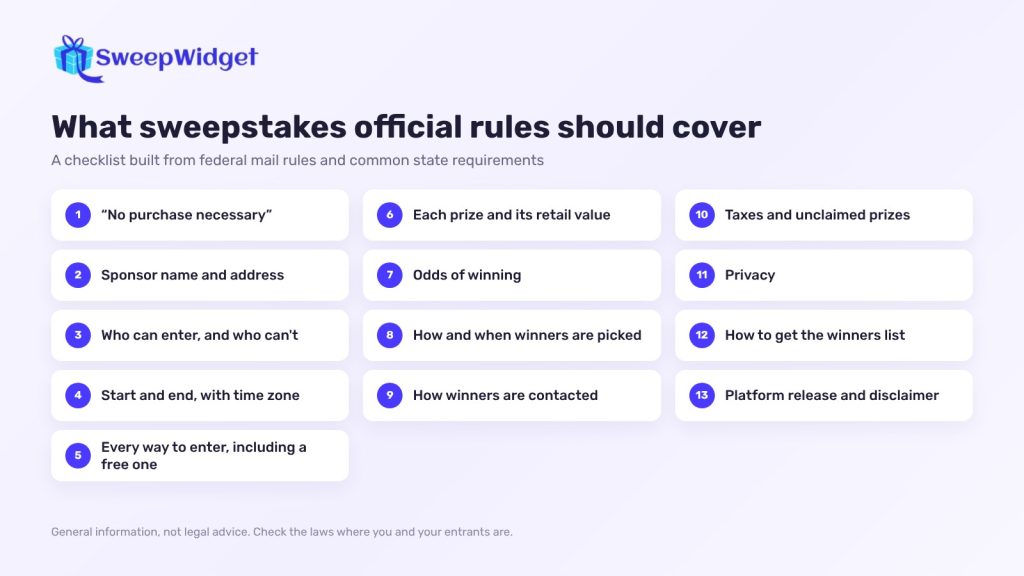
Use this as your checklist before you publish:
- “No purchase necessary” and “a purchase won’t improve your chances”
- Sponsor name, address and contact email
- Who can enter: countries or states, minimum age (and the age of majority where it’s higher), who’s excluded (staff, families)
- Start and end date, time and time zone
- Every way to enter, including a free method, and any entry limits
- Each prize: what it is, how many, its approximate retail value (ARV)
- Odds of winning
- How and when winners are picked, and who picks them
- How winners are contacted, and the deadline to reply
- Taxes, substitutions and what happens if a prize goes unclaimed
- Privacy: what you do with entrants’ details
- How to get the winners list
- A platform release and disclaimer if you use social media
Sample official rules and terms and conditions template
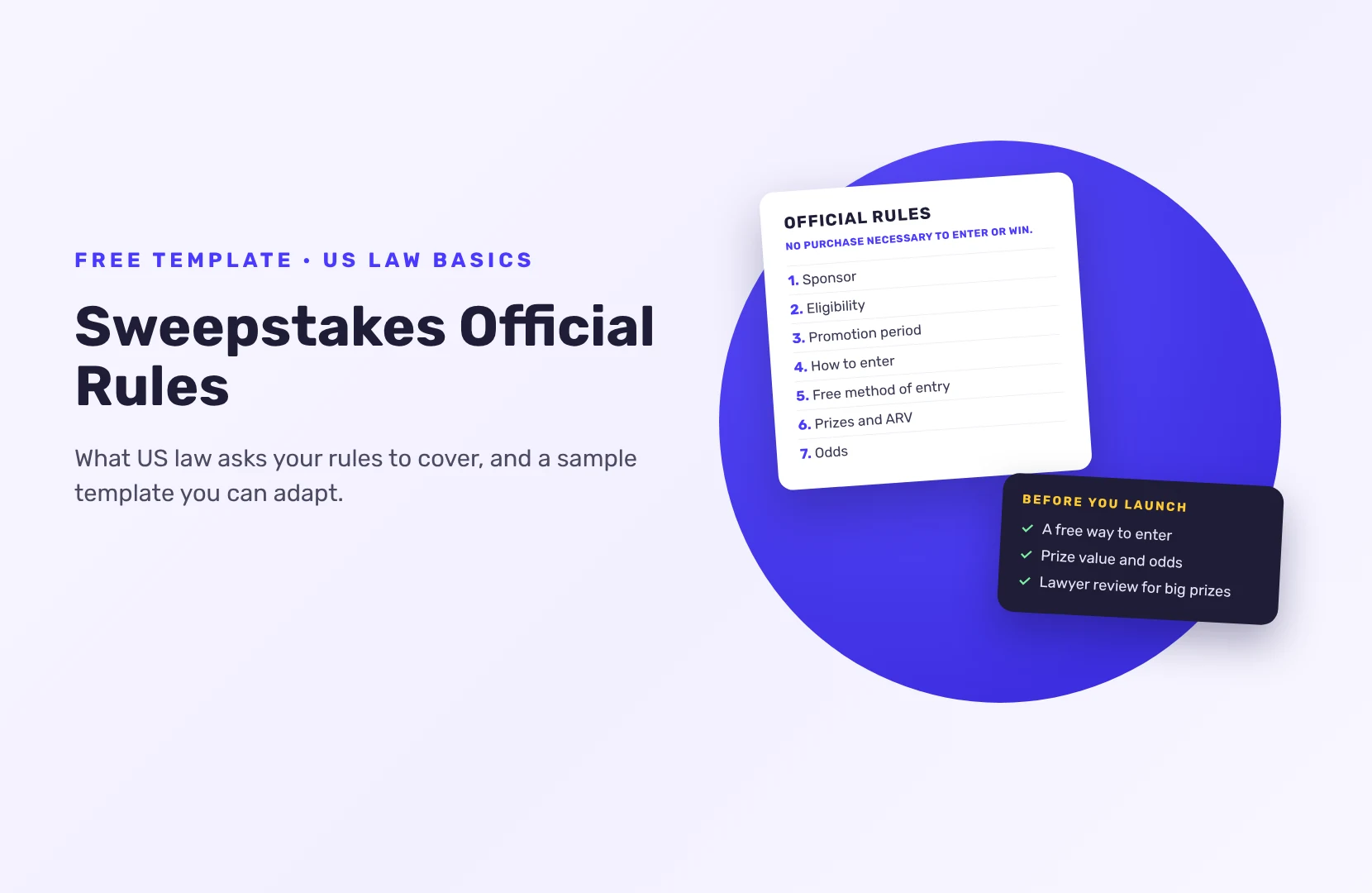
Sample template: adapt it to your promotion and have it reviewed. Then replace every [bracket]. Delete any section that doesn’t apply, and add anything your state, your prize or your platform needs. The three subheadings are only there to make it easier to read, so leave them out when you copy.
Header, sponsor and how to enter (sections 1 to 5)
[PROMOTION NAME] OFFICIAL RULES
NO PURCHASE NECESSARY TO ENTER OR WIN. A PURCHASE WILL NOT INCREASE YOUR CHANCES OF WINNING. VOID WHERE PROHIBITED.
1. Sponsor. [Legal company name], [street address, city, state, ZIP, country], [contact email] (“Sponsor”).
2. Eligibility. Open to legal residents of [countries / states] who are [18] or older and have reached the age of majority in their state of residence (19 in Alabama and Nebraska, 21 in Mississippi) at the time of entry. Employees of Sponsor, its agencies, their immediate families and people living in their households can’t enter.
3. Promotion period. Starts [date] at [time] [time zone] and ends [date] at [time] [time zone]. Sponsor’s clock is the official clock. Entries received outside this period won’t count.
4. How to enter. Visit [entry page URL] and enter your name and email. You can earn extra entries by [list each action and what it’s worth]. Limit: [number] entries per person. Entries made by automated means will be disqualified. [If entrants post on social media, add:] Posts must include #[Brand]Sweepstakes at the start of the caption.
5. Free method of entry. [Describe it. For example: mail a postcard with your name, email and mailing address to [address], postmarked by [date]. Each postcard earns [number] entries, limit [number] per person.] Free entries have the same chance of winning as all other entries.
Prizes, odds and winners (sections 6 to 11)
6. Prizes. [Number] winner(s) will receive [prize description]. Approximate retail value (ARV): $[amount] each. Total ARV of all prizes: $[amount]. No cash alternative or transfer. However, Sponsor may substitute a prize of equal or greater value if the listed prize is unavailable.
7. Odds. Odds of winning depend on the number of eligible entries received.
8. Winner selection. Winners will be picked in a random drawing from all eligible entries on or about [date] [, weighted by the number of entries each person earned]. Sponsor’s decisions are final.
9. Notification. Winners will be emailed within [number] days of the drawing and must reply within [number] days. If a winner doesn’t reply, is ineligible or doesn’t follow these rules, the prize may be forfeited and an alternate winner drawn. Sponsor may ask a winner to confirm eligibility in writing before the prize is sent.
10. Disqualification. Sponsor may disqualify entries made with fake or multiple accounts, automated tools, or any method that tampers with the entry process or breaks these rules.
11. Taxes. Winners are responsible for all taxes on their prize and any costs not listed here. Sponsor may also ask for tax information and issue a tax form where required.
Legal terms (sections 12 to 18)
12. Publicity. Where allowed by law, and with the winner’s consent, Sponsor may use the winner’s name and city in announcements of the result.
13. Changes and cancellation. If fraud, a technical failure or anything else outside Sponsor’s control affects the promotion, Sponsor may [modify / suspend / cancel] it and pick winners from eligible entries received before the problem, where allowed by law.
14. Release and limitation of liability. By entering, entrants release Sponsor from liability for any loss or injury arising from the promotion or the prize, to the extent allowed by law. Sponsor is not responsible for entries that are lost, late or not received because of technical problems. [Have your lawyer review this section.]
15. Privacy. Sponsor collects entrants’ names, email addresses and [other data] to run the promotion [and to send marketing emails if you opt in]. See [privacy policy URL].
16. Platform release. This promotion is in no way sponsored, endorsed or administered by, or associated with, [Instagram / Facebook / TikTok / other platform]. Each entrant also releases [platform] from any liability connected with it.
17. Winners list. For the names of winners, email [contact email] by [date].
18. Governing law. These rules are governed by the laws of [state / country].
How to fill it in without missing anything
- Use your legal company name in section 1, not just your brand name, with a real address.
- Then match the dates and time zone to the giveaway settings exactly.
- List every entry method and what it’s worth. That way, entrants can work out how their entries were counted, too.
- Add the free entry method if anything costs money. Otherwise, a required payment or purchase turns a free sweepstakes into a lottery. See no purchase necessary for how many entries a free entry should get.
- Add up the total prize value. Over $5,000 brings the New York and Florida filing rules above into play if people in those states can enter. Rhode Island’s line is lower: $500 for retail promotions (see is my giveaway legal?).
- Keep promises you can keep. For example, if you say you’ll contact winners within 48 hours, do it.
- Only disqualify for reasons your rules list. Florida’s statute makes it unlawful for an operator to “arbitrarily” remove or reject entries. Write your reasons into section 10 (fake accounts, bots, people outside the eligible area), then apply them the same way to everyone.
- Check the age. Eighteen is standard, but the age of majority is 19 in Alabama and Nebraska and 21 in Mississippi (Verrill). Also, prizes like alcohol need 21 or older everywhere.
Short rules vs full rules
Your social posts and entry page don’t need the full text. Instead, put the short version where people enter: how to enter, who can enter, the end date and time zone, the prize and its value, “no purchase necessary” and a link to the full rules. Florida’s statute is a good model: the ad can give the main terms if it adds a website, toll-free number or mailing address for the full rules.
How to add official rules in SweepWidget
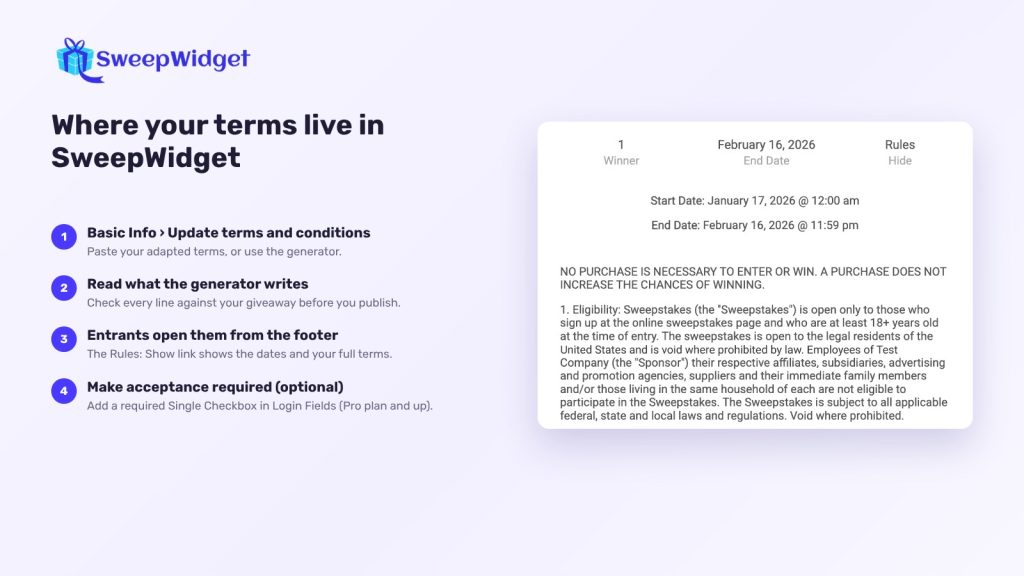
- Open your giveaway and go to the Basic Info tab.
- Click Update terms and conditions. Paste your own rules into the text box, or click Terms and conditions generator (on every paid plan).
- The generator asks you to agree that you’re responsible for making sure the rules fit the laws where you run the giveaway. Then click I Agree.
- Fill in the form: company name and address, eligibility, minimum age, prize list and retail value, time zone, dates, contact email and privacy URL.
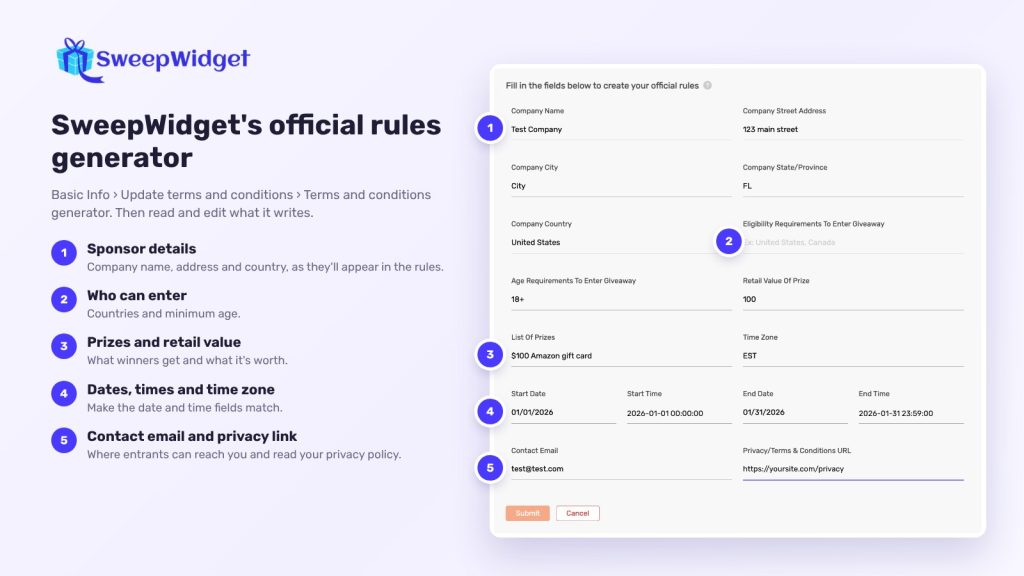
- Click Submit. The rules then start with “No purchase is necessary to enter or win” and fill your text box.
- Read every section and edit it. Also add anything your promotion needs that isn’t there, such as your free method of entry and an odds statement.
- Click Save & Publish. After that, entrants see a Rules: Show link in the giveaway footer, which opens the start and end dates and your full rules.
To ask entrants to accept the rules before they enter, add a Single Checkbox custom field (Pro plan and up) from the Login Fields tab and make it required.
Two more settings also help you enforce what the rules say. Geo-targeting (Premium plan and up) lets only people in the countries, or US states, you choose enter. And if your free method is mail-in, you can upload those entries from a CSV file, with an entry amount per person (Premium plan and up), so they go into the same draw.
Planning to give entries for purchases? Read how to offer a free alternative method of entry (AMOE) before you write your rules.
FAQ
For mailed sweepstakes, federal law requires the rules and key disclosures. States like New York and Florida require filed rules for large prize pools. Even when no law asks, rules are your record of how the promotion worked, and Meta’s Pages policy makes the host responsible for the official rules of any promotion run on Facebook.
It’s the safest habit. They tell entrants who can enter and how the winner is chosen, and they’re what you point to if anyone disputes the result.
Approximate retail value: what the prize would cost to buy. Federal mail rules ask for the estimated retail value of each prize, and the IRS counts a prize’s fair market value as the winner’s income.
Mailed sweepstakes must give the estimated odds of winning each prize. Online, most sponsors say the odds depend on the number of eligible entries.
It says the giveaway doesn’t apply where the law doesn’t allow it. It doesn’t replace checking the rules in the places you open entry to.
Don’t. Their eligibility, prizes, dates and free entry method won’t match yours. Start from a template and fill it in for your own promotion.