Sweepstakes vs Contest vs Lottery: What Is the Difference?
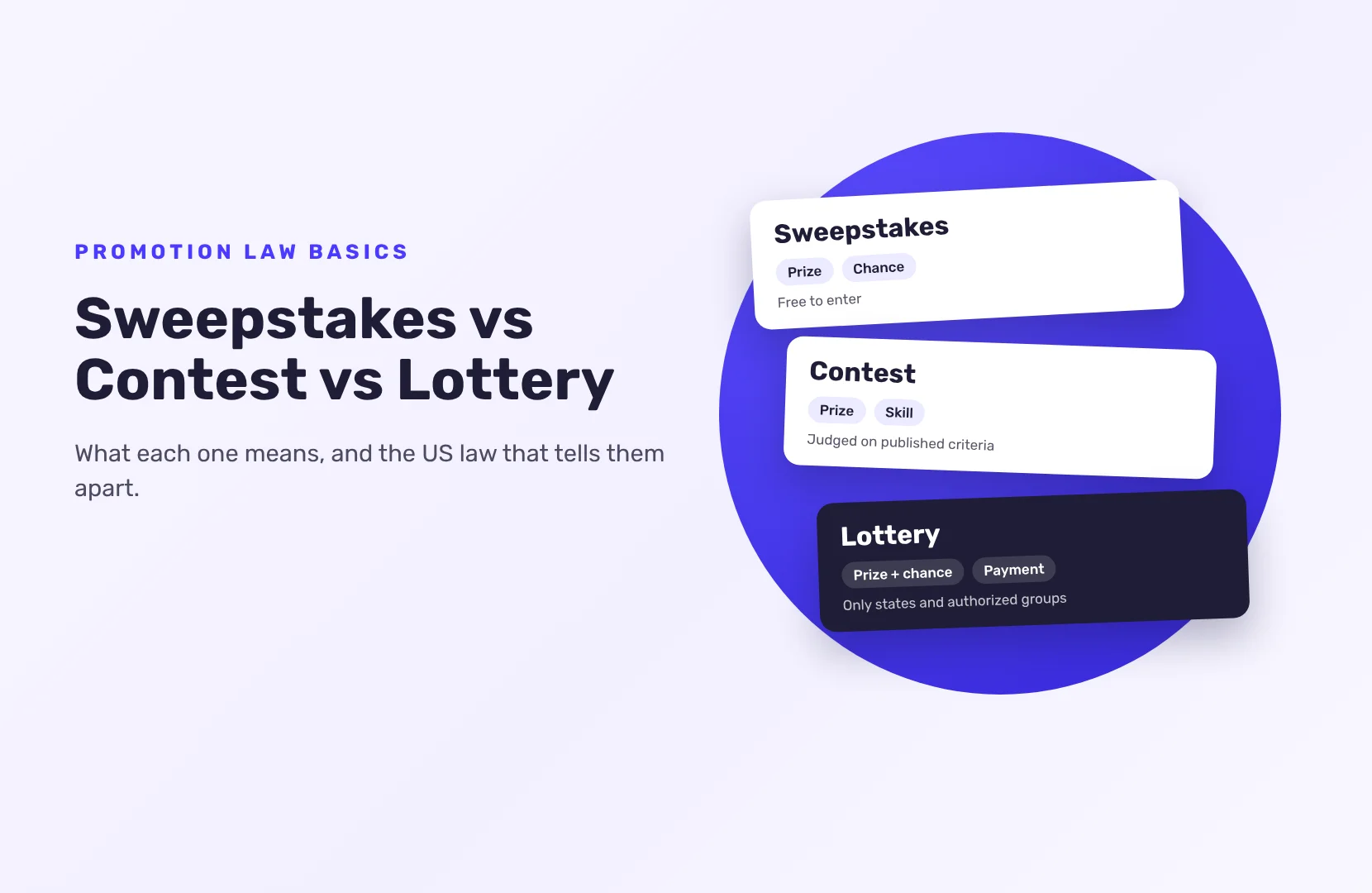
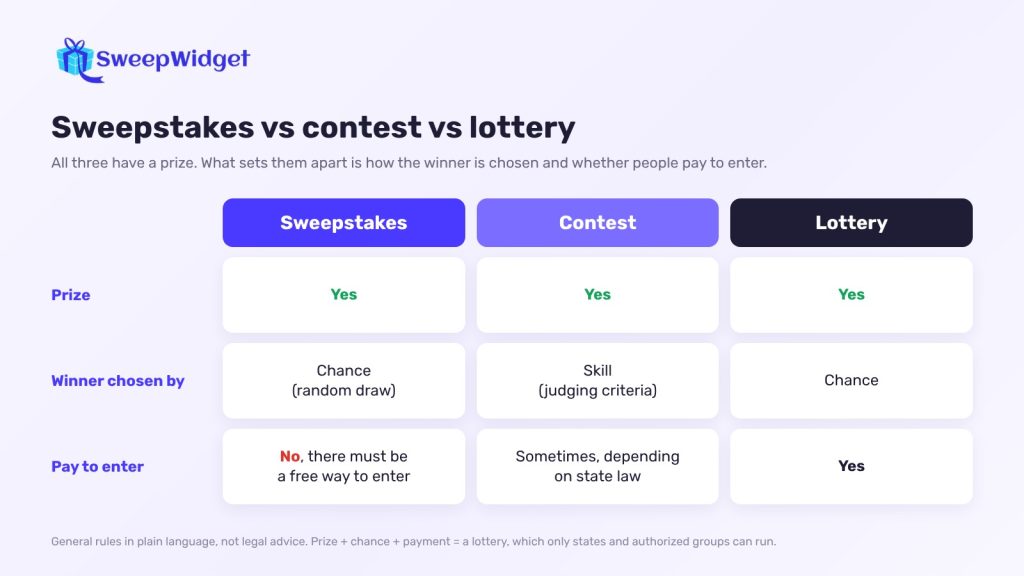
A sweepstakes is a free prize draw where the winner is picked by chance. A contest picks the winner by skill, judged against criteria you publish. A lottery combines a prize, chance and a payment to enter, and in the US it’s generally reserved for state lotteries and charities that a state allows to run one.
This guide explains the general rules in plain language. It isn’t legal advice. Rules change and depend on where you and your entrants are, so check with a lawyer before you launch a large or multi-state promotion.
The three parts: prize, chance, consideration
Every prize promotion is sorted by three questions:
- Is there a prize? Anything of value.
- Does chance pick the winner? A random draw, rather than skill.
- Is there consideration? Do people have to pay or buy something to enter?
When all three are present, you have a lottery. That’s how most states define it (Holland & Knight). New York’s definition has the same three parts: players pay for chances, winners are picked by chance, and winners get something of value (N.Y. Penal Law §225.00).
Take one part away and the promotion changes type. Remove the payment and it’s a sweepstakes. Replace chance with skill and it’s a contest. Consideration usually means money or a purchase, but in some states a lot of time or effort to enter (a long survey, say) can count too (Kilpatrick Townsend). Keep required steps light.
What is a sweepstakes?
A sweepstakes is a prize given away by chance to someone who didn’t have to pay to enter. Federal postal law puts it in one line: “a game of chance for which no consideration is required to enter” (39 U.S.C. §3001(k)). The FTC tells consumers the same thing: real sweepstakes are free and by chance (FTC).
Most “giveaways” on Instagram, TikTok or a website are sweepstakes: people enter, a winner is drawn at random. Instant win games are sweepstakes too, because chance decides who wins on the spot.
A sweepstakes can still give extra entries for actions like following you, joining a newsletter or referring a friend. If it gives entries for purchases, it needs a free way to enter as well, and buying can’t be the only way to improve your odds.
What is a contest?
A contest picks winners on merit: the best photo, the best recipe, the right answer. Federal mail law, in its rules for contests that charge to enter, defines a skill contest as one where “the outcome depends predominately on the skill of the contestant” (39 U.S.C. §3001(k)).
Two things follow from that:
- Chance can’t decide it. New York calls any game where the outcome depends “in a material degree upon an element of chance” a contest of chance, even if skill also plays a part (N.Y. Penal Law §225.00). A “contest” where the judges pick at random is really a sweepstakes.
- Your judging has to be written down. For contests sent by mail, federal law asks the rules to describe the judging method, the judges’ qualifications if someone other than the sponsor judges, the date winners are decided and each prize’s quantity, value and nature (39 U.S.C. §3001(k)). It’s a good list for any contest.
Some contests charge an entry fee or ask for a purchase. Because there’s no chance involved, most states allow that, but a few don’t (Kelley Drye; Venable gives Arizona, Colorado, Maryland and North Dakota as examples). Check the states you’re open to before you charge.
Public voting needs care too. If the most votes wins, the result can depend on popularity rather than skill, and some states would likely treat it as chance (Olshan). A safer set-up is to use votes to pick finalists or as part of the score, judge the winner against criteria in your rules, and limit votes per person.
What is a lottery?
A lottery is a prize draw people pay to enter. Prize, chance and consideration, all three.
Businesses generally can’t run one. In New York, a lottery is “an unlawful gambling scheme” (N.Y. Penal Law §225.00). In Florida, it’s unlawful to “set up, promote, or conduct any lottery for money or for anything of value” (Fla. Stat. §849.09). Federal law also bars mailing lottery tickets and ads (18 U.S.C. §1302), with exceptions for state lotteries and for lotteries that a state allows nonprofits, government bodies and, occasionally, businesses to run (18 U.S.C. §1307).
Where do raffles fit?
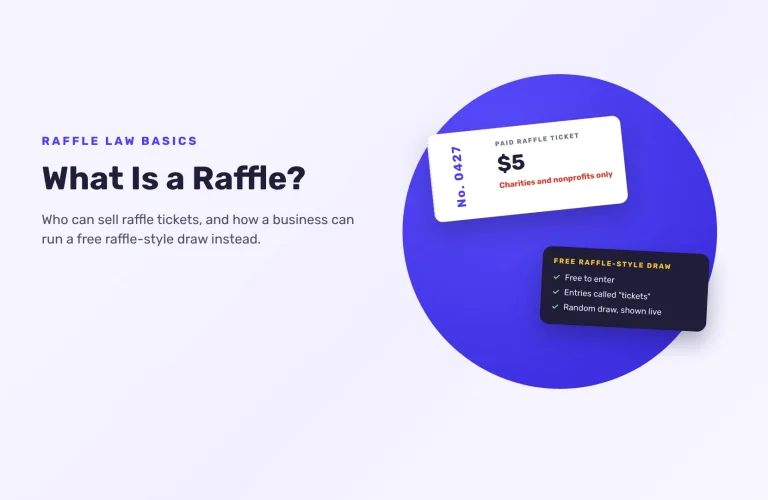
A raffle is a paid-ticket draw, so it’s a type of lottery. States allow raffles mainly for charities and similar groups. New York, for example, defines a raffle as a game of chance where “a participant pays money in return for a ticket” and limits it to authorized religious, charitable, educational, fraternal and service organizations (N.Y. Gen. Mun. Law §186). A free online “raffle” is a sweepstakes with a random draw. More in how to do a raffle online.
Sweepstakes vs contest vs lottery at a glance
| Sweepstakes | Contest | Lottery | |
| Prize | Yes | Yes | Yes |
| Winner chosen by | Chance (random draw) | Skill (judging criteria) | Chance |
| Pay to enter | No, there must be a free way | Sometimes, depending on state law | Yes |
| Who can run it | Businesses and individuals | Businesses and individuals | States and authorized groups such as charities |
Which one should your business run?
- Run a sweepstakes when you want reach: more entrants, more email signups, more followers. It’s quick to enter and easy to explain.
- Run a contest when you want content or effort: photos, videos, ideas. Usually fewer people enter, but you get something you can use (with their permission).
- Don’t run a lottery. If you want people to buy to take part, give entries for purchases and offer a free way to enter alongside them.
How SweepWidget handles each
- Sweepstakes. Winners are drawn at random from all eligible entries, weighted by entries, from Manage Entries > Pick A Winner. You can draw up to 250 winners at a time (your plan sets the total: 1 on Free, 50 on Pro, 250 on Business, 1,000 on Premium) and set a minimum or maximum number of entries to qualify (help doc).
- Contests. SweepWidget’s photo and video contest (Pro plan and up) lets entrants upload work to a gallery. You choose whether the winner is decided by votes or picked by you, so you can judge against your own published criteria, and you can limit votes per person and require voters to log in (help doc). A random pick from the gallery would make it a sweepstakes instead. More in how to run a photo contest online.
- Purchase entries. On Shopify and WooCommerce (Pro plan and up), purchases can earn entries. When you add a purchase entry method, SweepWidget adds a Refer-A-Friend entry method automatically as a free way to earn entries. Add a direct free entry as well.
- Rules. The terms and conditions generator builds sweepstakes rules from your details, starting with “NO PURCHASE IS NECESSARY TO ENTER OR WIN. A PURCHASE DOES NOT INCREASE THE CHANCES OF WINNING.” It asks you to confirm the rules fit the laws where you run the giveaway, and you can edit everything. See sweepstakes official rules for what to check.
Giving entries for purchases? Read how an alternative method of entry (AMOE) keeps a sweepstakes free to enter. Or see what “no purchase necessary” means.
FAQ
A promotion where a prize is given away by chance and nobody has to pay to enter. Federal law calls it “a game of chance for which no consideration is required to enter.”
Usually, yes. If the winner is drawn at random and entry is free, a giveaway is a sweepstakes in legal terms.
How the winner is picked. A contest is decided by skill against set criteria; a sweepstakes is decided by chance.
Generally not. Lotteries combine prize, chance and payment, and states reserve them for state lotteries and authorized groups such as charities.
A paid raffle is a lottery. A free raffle, where nobody pays for a ticket, works like a sweepstakes.